
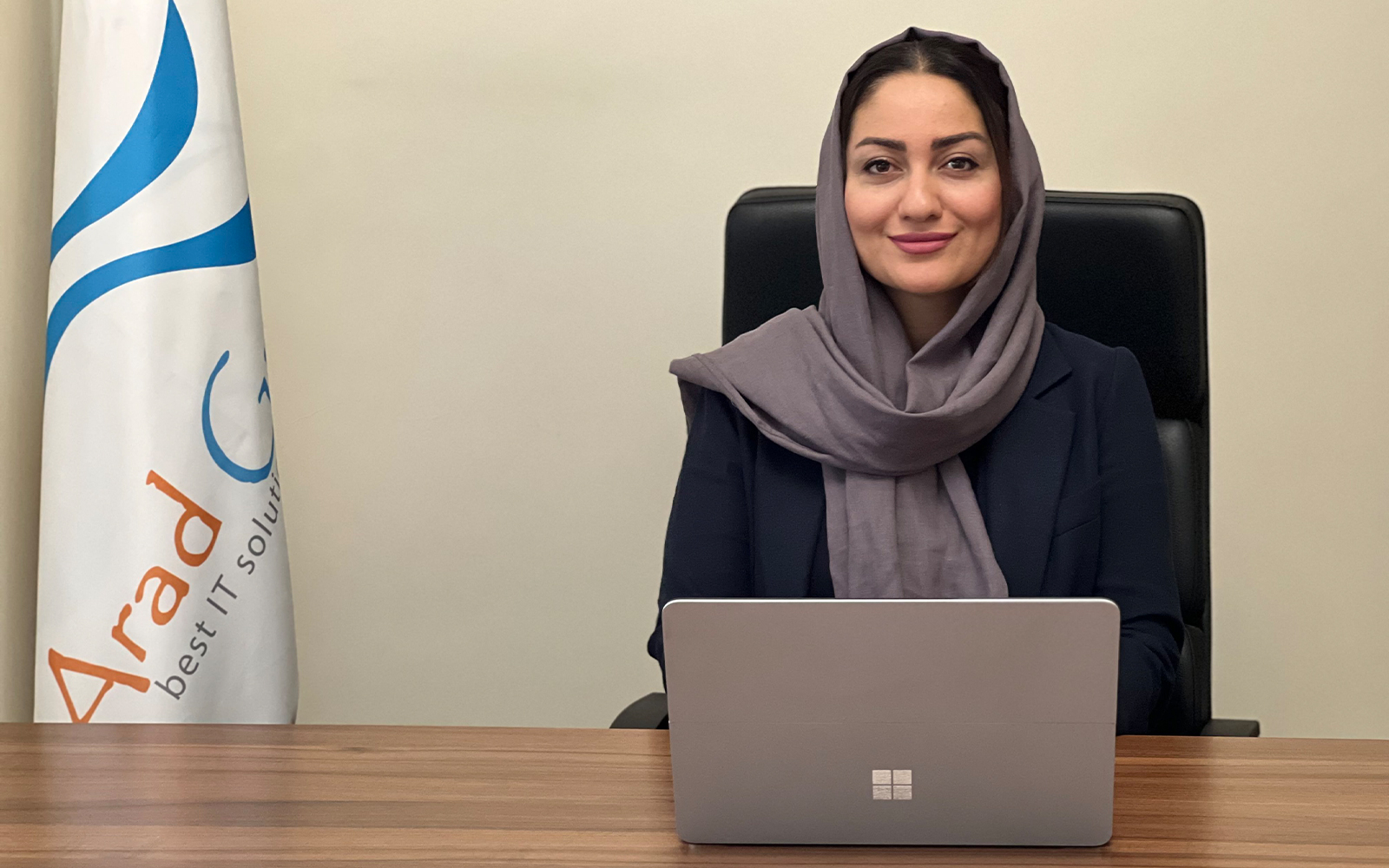
Arad ITC began its operations in 2005 in the field of communications and financial infrastructure. Over nearly two decades, the company has become one of Iran’s established players in secure, domestically developed messaging solutions. By focusing on scalable, flexible platforms built on local technologies, Arad plays an important role in handling a significant portion of the country’s banking and notification traffic.
In our interview with Atefeh Khiabanchian, CEO of the company, she discussed Arad’s strategic position within Iran’s communications ecosystem and explained the company’s growth path, technical and security challenges, its share of more than 60 percent of banking messaging traffic, domestic solutions such as AUMG and SMS Firewall, and its plans to expand into international markets including Oman, India, and Europe.
She emphasized that SMS remains the backbone of secure communications in the country, while the development of artificial intelligence, behavioral security, and national-scale scalability are among Arad’s most important priorities for the future.
Developing Domestic Infrastructure for Secure and High-Speed Messaging
The development of domestic infrastructure for digital communications is one of the key paths for the growth of Iran’s messaging industry—a path Arad Rayaneh Lian has pursued for nearly two decades.
Atefeh Khiabanchian, CEO of the company, explained:
“We began our operations in 2005 with the goal of creating a reliable, scalable platform aligned with the country’s real needs in communications and financial infrastructure. From the outset, our focus has been on developing fully domestic platforms capable of meeting the requirements of banks, telecom operators, government organizations, and large enterprises for fast, secure, and flexible messaging.”
She continued:
“In this context, we have developed a portfolio of key products including Arad Unified Messaging Gateway (AUMG), SMS Firewall, SMS Wallet, Arad SMPP Gateway, and Horse Messaging. Today, these solutions are deployed as critical components of messaging infrastructure at the national level.”
“At present, more than 60 percent of the country’s banking and notification messages pass through Arad platforms. This significant share reflects our strategic position within Iran’s digital communications industry a position we have achieved and maintained through the high security standards, processing performance, and technical flexibility of our products.”
Developing AUMG and SMS Firewall to Meet Security and Availability Requirements
According to Arad’s CEO, the company has become one of the country’s major messaging technology providers by relying on stable infrastructure, strong security, and domestically developed products.
She said:
“Reaching a share of more than 60 percent of the country’s banking and notification SMS traffic is the result of years of focus on quality, standardization, innovation, and infrastructure reliability.”
“Banks and other sensitive organizations require platforms that operate around the clock, guarantee secure message delivery, perform reliably under very high traffic volumes, and provide accurate reporting and extensive customization capabilities.”
“By developing domestic solutions such as AUMG and SMS Firewall, we have sought to address these requirements. Providing support services tailored to the specific needs of each bank and organization has also played a key role in building trust. That trust has been our greatest asset and one of the main reasons we have reached our current position.”
Extensive Coverage Across Banks and Telecom Operators
Explaining the basis for Arad’s reported share of more than 60 percent of the country’s banking and notification messaging traffic, Khiabanchian stated:
“This figure is calculated based on the volume of messages transmitted through Arad platforms compared with the overall volume of messages sent nationwide. We use operator data and internal technical reports for this calculation, and through detailed analysis of this information, we determine our actual share of the country’s messaging ecosystem.”
She added:
“From the perspective of enterprise customers, a significant portion of the SMS traffic of major Iranian banks including Bank Mellat, Bank Sepah, Bank Melli Iran, Bank Saderat Iran, Ayandeh Bank, Central Bank of Iran, Refah Bank, Sina Bank, Sarmayeh Bank, and EN Bank is currently handled through our services.”
“Telecom operators such as Asiatech and ArianTel, messaging aggregators such as Jiring, and companies such as Mediana also rely on Arad infrastructure. This clearly demonstrates the company’s broad reach and prominent position within Iran’s digital messaging sector.”
National-Scale Scalability: One of the Greatest Technical Challenges
The development of Arad’s infrastructure has involved numerous challenges across technical, operational, institutional, and regulatory dimensions.
Khiabanchian explained:
“From a technical standpoint, our greatest challenges have included achieving national-scale scalability, handling traffic peaks, real-time processing at extremely high volumes, developing domestic libraries without dependence on foreign services that may be affected by sanctions, and simultaneously managing multiple operator routes.”
“To overcome these challenges, we have implemented advanced proprietary architectures, real-time processing, load balancing, Arad’s proprietary Message Broker, dedicated libraries for communications protocols such as SS7 and SMPP, and an internally developed failover system.”
She continued:
“Operationally, integration with the diverse infrastructures of banks and telecom operators, as well as the need for highly specific customization for sensitive organizations, have been among the major challenges.”
“We addressed these requirements by providing flexible deployment models -including Cloud, On-Premises, and Hybrid architectures- as well as fully customized services.”
“At the institutional and regulatory level, changing regulatory requirements and compliance with stringent security standards have also represented significant challenges. Through continuous coordination with regulators and rapid alignment with evolving standards, we have been able to manage these issues.”
SMS: The Backbone of Banking Communications in the Digital Age
Despite the rapid growth and increasing diversity of digital communication channels, SMS remains one of the most reliable and secure methods of communication for banks and other sensitive organizations in Iran.
Khiabanchian explained:
“SMS continues to play a vital role in transmitting sensitive information for several reasons. First, it does not require an internet connection and is available to virtually all mobile users, which becomes particularly important under various operational conditions.”
“SMS is also one of the simplest yet most dependable communication channels, making it accessible to virtually every user group, including those who may be less familiar with digital technologies.”
She added:
“SMS is widely recognized and trusted as the primary channel for delivering one-time passwords (OTPs) and security alerts. Another major advantage is its close integration with national identity-verification infrastructure, such as the Shahkar system, which strengthens the security and accuracy of identity verification.”
“Although newer channels such as push notifications and email serve as complementary tools, SMS continues to maintain a strong and difficult-to-replace position as the backbone of secure communications because of its standardization, broad accessibility, and universal availability across telecom operators.”
Rapid Threat Detection Through Behavioral Monitoring
Explaining Arad’s security approach, Khiabanchian said:
“For us, security is not merely a separate layer or individual tool; it is embedded throughout the architecture of our systems.”
“At the network layer, we prevent service disruption through segregated routing and full redundancy. At the content layer, our domestic SMS Firewall is capable of detecting and blocking phishing attacks, spoofing, and unauthorized messaging routes.”
“We also use behavioral monitoring and anomaly-detection systems to rapidly identify any unusual activity. Round-the-clock support and real-time monitoring are integral parts of our infrastructure.”
“In addition, our Failover and Disaster Recovery scenarios ensure service continuity and stability even in the event of an attack or infrastructure disruption.”
Oman, India, and Europe: Arad’s New Destinations
The CEO of Arad Rayaneh Lian also discussed the company’s future direction and a vision that extends beyond its role as a domestic messaging service provider.
She said:
“Our vision is to evolve from a service provider into an international infrastructure technology company. With this objective, we have begun expanding our presence in global markets. We have already established offices in countries such as Oman, and initiatives are underway to establish new offices in India and a European country.”
She identified product development and service diversification as other strategic priorities for Arad:
“By expanding our product ecosystem -including our Push Notification Platform, SMS Firewall, SMS Wallet- and strengthening collaboration with international operators and institutions, we intend to increase our presence in emerging markets such as Africa and Eastern Europe.”
“Developing security and analytical solutions based on artificial intelligence is another important step toward improving the quality and intelligence of our communications services.”
“Our ultimate goal is for Arad to become recognized globally as a trusted provider of secure, domestically engineered, and scalable messaging infrastructure, while making a meaningful contribution to the export of Iranian technology.”
“Along this path, we welcome technological cooperation with banks, telecom operators, and international partners, and we are ready to bring our knowledge and experience to regional and global markets.”