
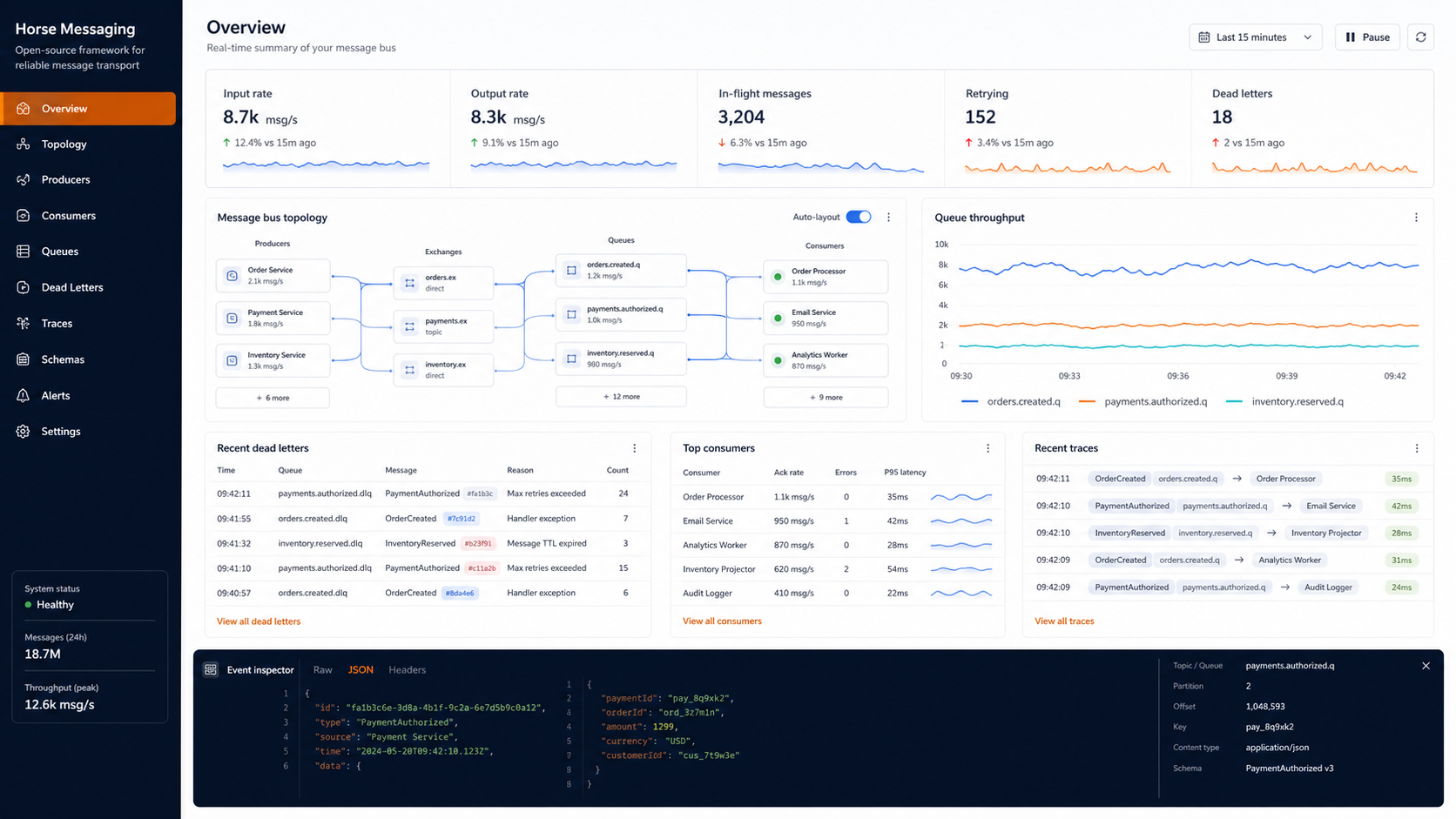
Horse Messaging brings persistent push/pull queues, channel broadcasting, direct client messaging, request-response proxying, remote transactions, events, routing and distributed cache capabilities together over an asynchronous client connection.
The operational challenge
For .NET teams building event-driven services, payment workflows, notification systems, IoT backends or application integration that benefit from a customizable communication framework.
Why Horse Messaging?
This product turns a fragmented, technically demanding workflow into an operation that can be governed and improved. Engineering, operations and business teams work from a shared view for policy configuration, service health and incident investigation instead of relying on disconnected tools and manual hand-offs.
Operational control and user experience
An administrative dashboard, filterable operational views, reporting, role-based access and an auditable event trail make daily work understandable. Workflows are designed so authorized teams can change configuration, review outcomes and diagnose issues without a permanent dependency on application developers.
Architecture, security and extensibility
A modular architecture supports phased growth, clear responsibility boundaries and controlled integration with existing systems. Authentication, authorization, auditing, sensitive-data protection, input validation and retention policies are configured around the organization’s security and governance requirements.
Deployment and professional services
The solution can be deployed on dedicated infrastructure, a private cloud or a managed cloud environment. Delivery can include discovery, solution architecture, migration planning, acceptance testing, team enablement and post-launch support, giving stakeholders a controlled path from evaluation to production.
How it fits the architecture
Horse Messaging sits as a dedicated layer between entry channels and backend services. This separation keeps routing, flow control and operational visibility out of consuming application code, so connections and policies can evolve without forcing every integrated system to change together.
Core capabilities
- Persistent push and pull queues
- Broadcast channels and direct client messaging
- Events, routing and request-response proxy
- Remote transaction coordination
- Distributed cache management
- Extensible server-side implementations
Common use cases
Typical projects include environments where for .NET teams building event-driven services, payment workflows, notification systems, IoT backends or application integration that benefit from a customizable communication framework It can also support phased integration, replacement of point-to-point connections and a clearer operational boundary between teams.
Integration and deployment
The final integration, capacity, availability and deployment model is defined after reviewing the existing architecture, peer protocols and operational requirements. This page intentionally makes no unverified performance, SLA or compliance claim.
Developers are welcome
We welcome developers, users and maintainers to review the code, improve documentation, open issues and contribute through pull requests.